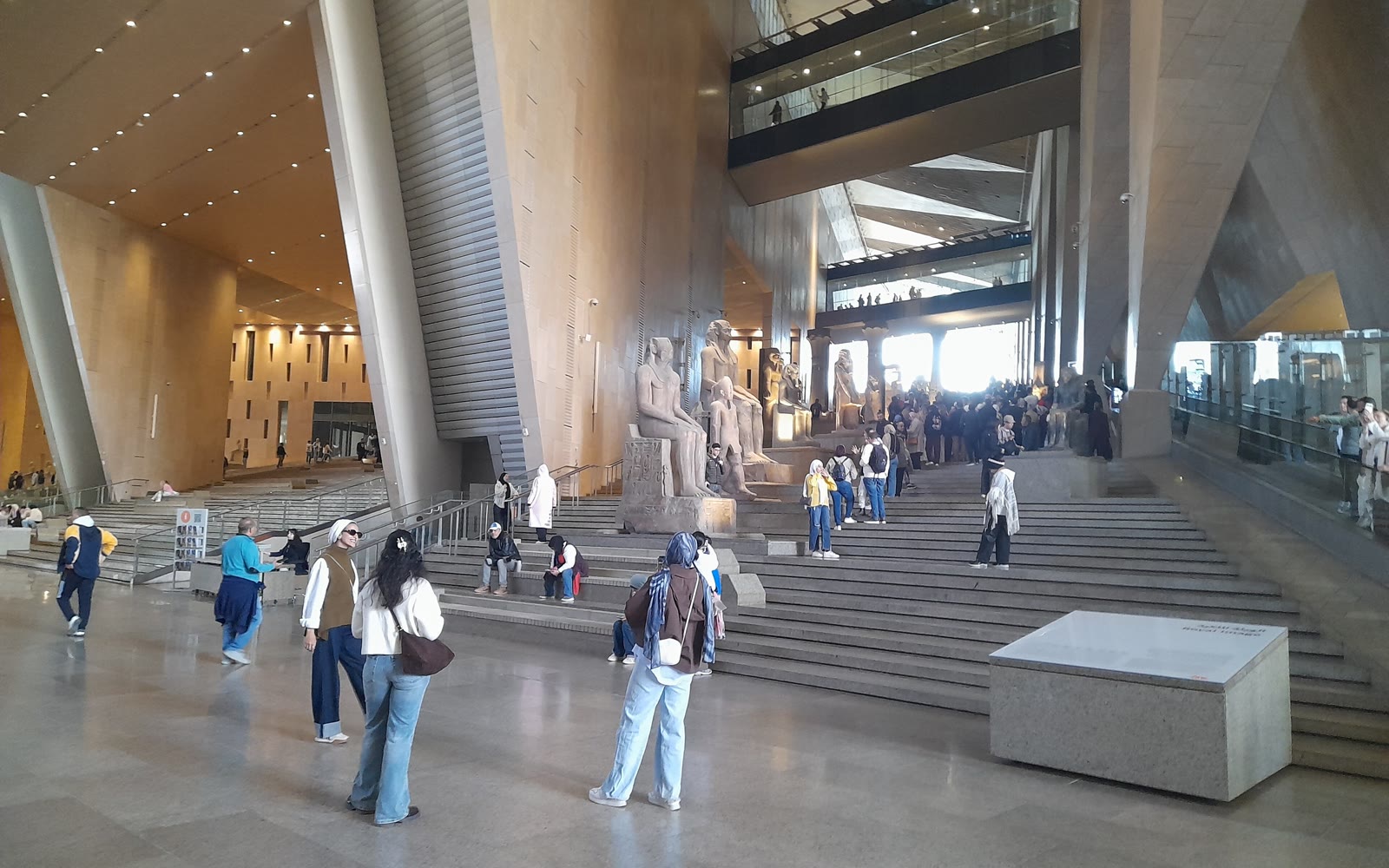
Giza is a place where scale can overwhelm sequence. The plateau offers an archaeological landscape; GEM offers a controlled chronological and thematic framework. They complement one another only when the day has enough time, weather tolerance and transport margin.
Use the museum to build time
Begin with the broad chronological galleries while concentration is strong. Locate major changes in settlement, political organisation, royal representation, religious practice and daily life. Once that spine exists, select one deep trail. A connected archaeological group or material theme will produce more understanding than moving from famous name to famous name.
Use the plateau to rebuild space
Museum objects are separated from their original scale and architecture. The plateau reverses that condition: distance, horizon, approach and physical effort become evidence. Notice how movement changes what can be seen. A plan that rushes from gallery case to monument without a pause loses the contrast that makes the pairing valuable.
Compare monument with museum object
Carry one relationship between the two settings. A royal statue can prompt questions about controlled pose and public approach; a relief fragment can direct attention to the wall and sequence from which it was removed; a tool or vessel can restore human work to a landscape dominated by stone architecture. The point is not to match every object to a monument. It is to notice what changes when portable evidence and built space are allowed to explain one another.
Choose an anchor
If the museum is the priority, protect several hours inside and make the plateau conditional. If the archaeological landscape is the priority, do not promise a complete museum afterwards. Tickets, opening conditions and entry routes can change, and the two sites are not one combined product. Check each official source separately.
Plan for the body
GEM involves long internal distances; the plateau involves sun, uneven surfaces and exposure. Comfortable footwear is not a generic travel suggestion here—it affects how much attention survives. Build water, food, rest and transport into the schedule. Visitors with mobility or sensory needs should confirm the complete route, including arrival, security, lifts, seating and toilets.
Leave transfer time visible
Do not treat the short distance on a map as an instant connection. Security, exits, pickup points, traffic and the time needed to reorient can turn a nominal transfer into the hinge of the whole day. Decide in advance which part will be shortened if the transfer expands. That decision protects the anchor experience and prevents the final hours from becoming a race against last admission.
Know when the day is complete
A museum day does not fail because one optional zone was removed. When labels stop becoming relationships, choose the best ending rather than adding another institution. Central Cairo and Old Cairo museums belong to separate days in most short itineraries.
Sources reviewed 28 July 2026: GEM visitor information ↗ · GEM ticket portal ↗. Display and visitor conditions may change.